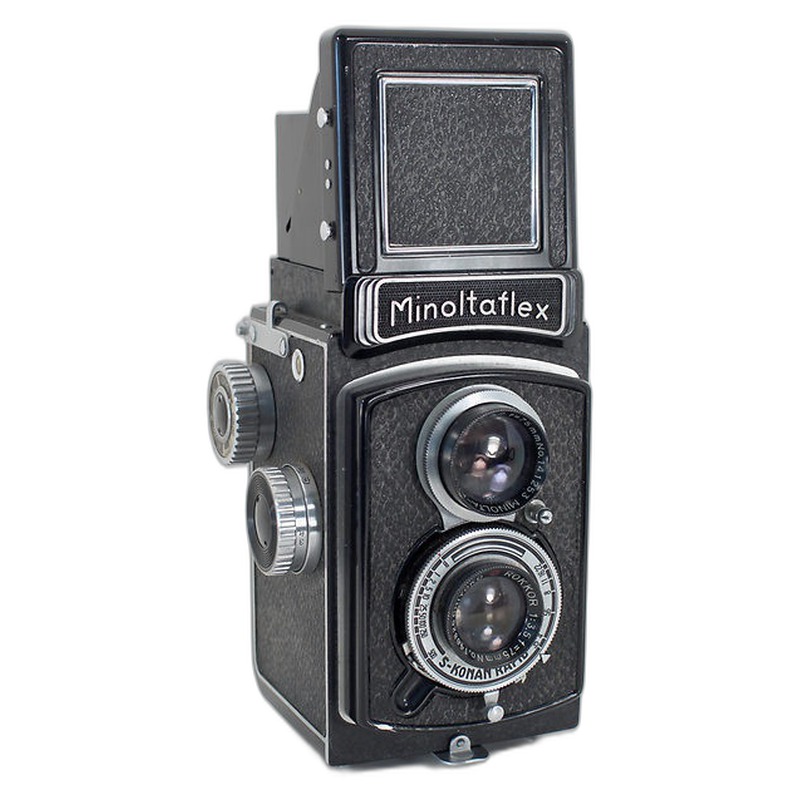
Minoltaflex II
Minolta · Japan · 1950–1954 (4 years) · 135 film
The Minoltaflex II represents a significant step in Minolta's post-war camera manufacturing evolution. Produced from 1950 to 1954, it was one of the first Japanese-made twin-lens reflex (TLR) cameras to gain wider attention, contributing to Minolta's reputation for producing quality equipment beyond simpler box cameras and early folders. As a 35mm TLR, it occupied a niche space, offering the unique waist-level viewing experience characteristic of TLRs while utilizing the readily available 135 film cartridge. The camera featured a coupled range-finder system for precise focusing, coupled shutter speeds, and a respectable selection of interchangeable Minolta-mount lenses, including options like a standard 75mm f/3.5. Its release coincided with Japan's emergence as a serious camera producer and Minolta's subsequent development of single-lens reflex systems, making it a foundational model in their product line.
While technically a TLR, the Minoltaflex II's 35mm format was unusual for this type of camera. Its build was robust for its era, featuring metal construction and a convenient top-mounted film advance knob. Despite its innovations for Minolta, such as coupled rangefinder focusing in a 35mm TLR, it ultimately didn't achieve the widespread acclaim or market dominance of some contemporary designs. Its significance lies more in its role as a transitional product showcasing Minolta's engineering capabilities and their progression towards the more successful SR series SLRs. Collectors value it as a representative example of early Japanese TLR innovation and Minolta's initial foray into this complex format, though it remains somewhat overshadowed by other Japanese TLRs like the Ricohflex or Rolleicord in the broader vintage camera market.
Specifications
| Film Format | 135 |
/main.jpg)
/main.jpg)
/main.jpg)
 Enjoy this museum? Support on Ko-fi