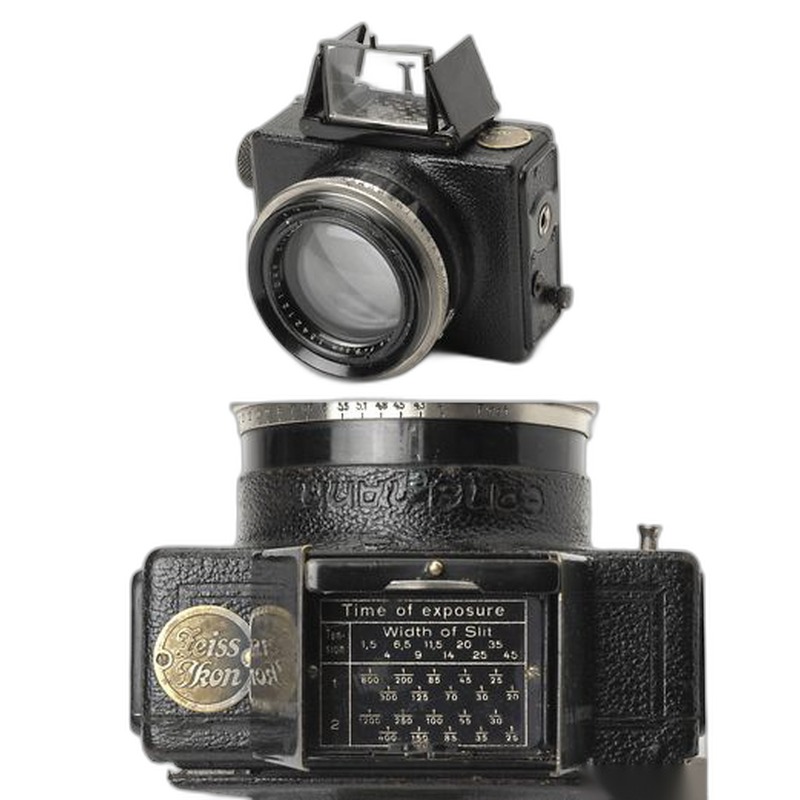
Zeiss Ermanox 858
Zeiss · Germany · 1927–1931 (4 years) · 135 film
The Ermanox, introduced in 1927 and produced until 1931, stands as a pivotal camera in the evolution of small-format photography. Developed by Zeiss Ikon, it emerged alongside the revolutionary Leica I, cementing the 135 film cassette as a viable format for serious still photography. Its most defining feature was its exceptional lens speed; equipped with a remarkable 50mm f/2 Ernostar lens (and later available with an 85mm f/2 Ernostar), the Ermanox possessed an unheard-of light-gathering capability for its era. This made it uniquely suited for "available light" photography, allowing photographers to capture candid moments in dim interiors or at dusk without the cumbersome and intrusive use of flash powder or magnesium lamps. It became the tool of choice for pioneers of modern photojournalism and street photography, most notably Alfred Eisenstaedt, who famously used it to capture candid images for the early Berliner Illustrirte Zeitung.
Design-wise, the Ermanox was a sophisticated camera for its time. It featured a compact, rigid body constructed from aluminum and die-cast metal, emphasizing durability and precision engineering. The focal plane shutter offered speeds up to 1/1000th of a second, enabling sharp action capture. The innovative lens mount facilitated quick lens changes between the standard 50mm f/2 and the telephoto 85mm f/2 options. While sharing the basic operational principles of contemporary Leicas, such as a coupled rangefinder (initially external, later integrated) and a wind-on lever, the Ermanox distinguished itself primarily through its superior optical performance in challenging lighting conditions. It represented Zeiss Ikon's direct and formidable response to the emerging Leica phenomenon, showcasing German optical engineering prowess at its peak and providing photographers with a powerful new tool for low-light realism.
Specifications
| Film Format | 135 |
/main.jpg)
/main.jpg)
/main.jpg)
/main.jpg)
 Enjoy this museum? Support on Ko-fi