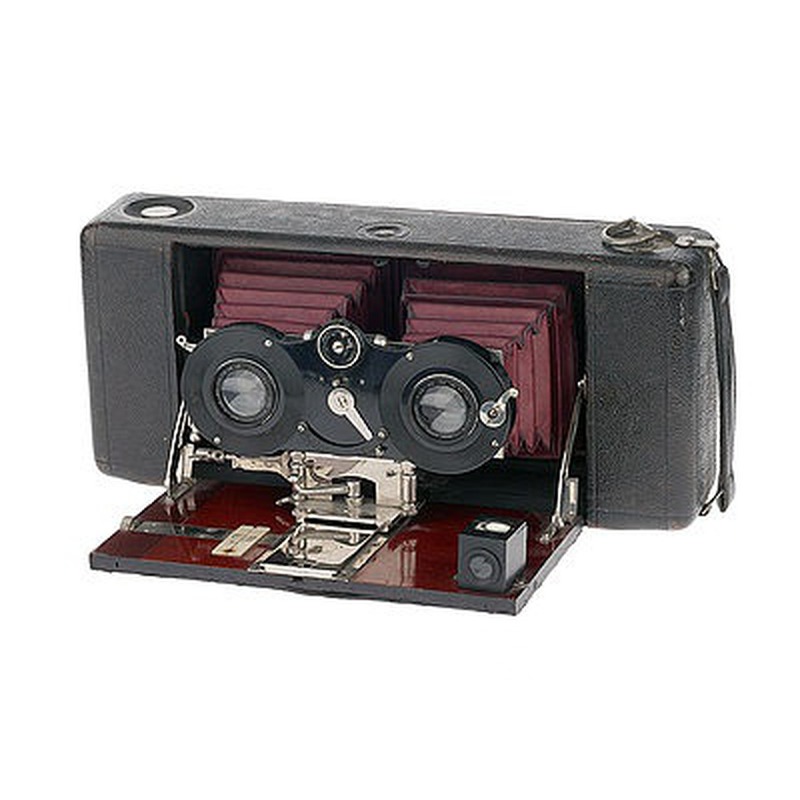
Kodak Stereo-Kodak Model 1
Kodak · USA · 1917–1925 (8 years) · 135 film
The Stereo-Kodak Model 1 represents one of Kodak's early ventures into 35mm photography, produced from 1917 to 1925. Unlike Kodak's more popular roll-film cameras of the era, this specialized model utilized 35mm film to create stereo pairs—two slightly offset images that could be viewed through a stereoscope to produce a three-dimensional effect. The camera featured a dual-lens system with fixed focal lengths, designed to capture the precise parallax needed for stereo imaging. Construction was typical of Kodak products from this period, with a metal body and simple shutter mechanism, likely offering basic shutter speeds suitable for outdoor daylight photography. As one of the earliest attempts by Kodak to popularize the 35mm format, the Stereo-Kodak Model 1 represents an important but transitional product that catered specifically to stereo photography enthusiasts rather than the general photography market.
The camera's significance lies in its timing and manufacturer—Kodak entering the 35mm field several years before Leica's groundbreaking 1925 introduction. This positioned Kodak as an early adapter of small-format technology, though the Stereo-Kodak Model 1 itself remained a specialized tool rather than a revolutionary general-purpose camera. Its production during World War I through the mid-1920s places it at a fascinating crossroads in photographic history, representing both the culmination of stereoscopic photography's popularity and the dawn of the 35mm era that would eventually transform photography.
Specifications
| Film Format | 135 |
/main.jpg)
 Enjoy this museum? Support on Ko-fi