Pricing
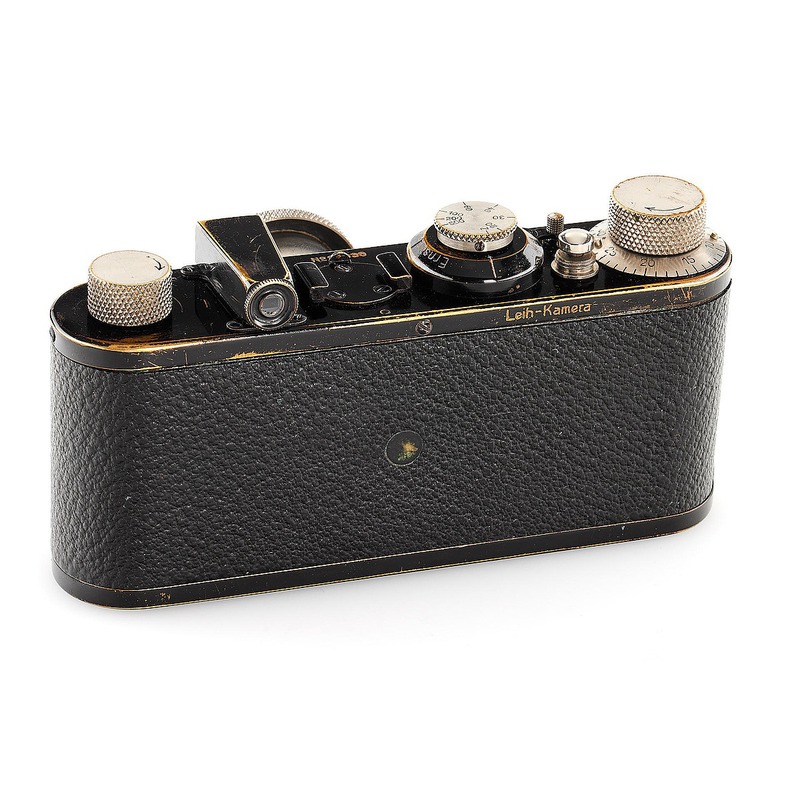
Leica I Mod A 'Leih-Kamera'
Leica · Germany · 1925–1930 (5 years) · 135 film
The Leica I Mod A 'Leih-Kamera' represents one of the most pivotal moments in photographic history, marking the dawn of practical 35mm photography. Introduced in 1925 during the transition from plate to roll film formats, this camera fundamentally altered how photographers worked by offering unprecedented portability without sacrificing image quality. As one of the earliest commercial 35mm cameras, it established a new standard that would eventually dominate photographic practice for decades. The "Leih-Kamera" (loan camera) designation suggests this particular variant may have been used as a demonstration or rental model, highlighting Leica's early understanding of the importance of hands-on experience for potential customers.
Technically, the Leica I featured a compact body crafted from precision-milled metal components, a coupled rangefinder for accurate focusing, and interchangeable lenses that could be swapped by the photographer. The camera employed a focal-plane shutter with speeds from 1/20 to 1/500 second, revolutionary at the time for maintaining compactness while offering exposure flexibility. The 135mm format (24×36mm) became the standard for 35mm photography largely due to the success of cameras like the Leica I, which demonstrated the viability of smaller film formats for professional work. The 'Leih-Kamera' likely shared these core technical specifications while perhaps featuring distinctive markings or modifications to identify it as a loaner unit.
The impact of the Leica I on photographic practice cannot be overstated. It liberated photographers from cumbersome equipment, enabling candid street photography, photojournalism, and documentary work in ways previously impossible. Photographers such as Henri Cartier-Bresson and Alfred Eisenstaedt adopted similar Leica models, developing the "candid photography" aesthetic that defined mid-century photojournalism. The camera's portability and quiet operation allowed photographers to become less obtrusive subjects of their own work, fundamentally changing the relationship between photographer and subject. As one of the earliest iterations in what would become Leica's legendary series of 35mm cameras, the Mod A 'Leih-Kamera' stands as a foundational piece in the evolution of modern photographic technology.
Specifications
| Film Format | 135 |
/main.jpg)
/main.jpg)
_close_focus/main.jpg)
/main.jpg)
/main.jpg)
/main.jpg)
 Enjoy this museum? Support on Ko-fi