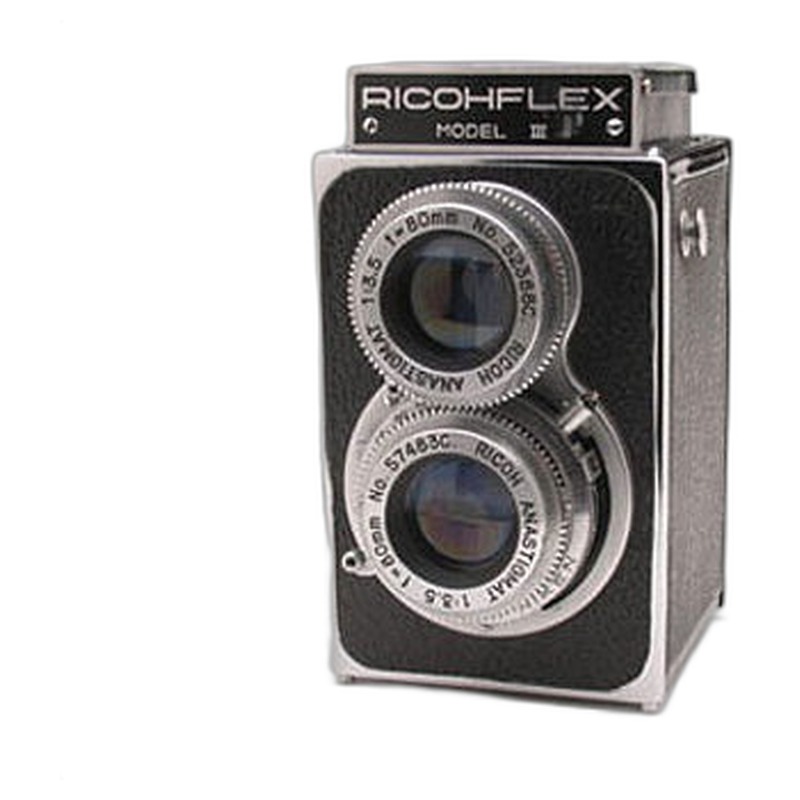
Riken Ricohflex Model III
Riken · Japan · 1950 · 135 film
The Ricohflex Model III, introduced by Riken in 1950, represents a straightforward 35mm twin-lens reflex (TLR) camera targeting the enthusiast and advanced amateur market. Building upon the earlier Ricohflex models adapted for 35mm film, this iteration maintained the classic TLR form factor familiar to users of medium format Rolleis or Rolleicords, albeit scaled down for the smaller film format. It featured coupled rangefinder focusing, essential for sharp 35mm photographs, and a shutter offering speeds likely ranging from around 1 second to 1/500th, along with B and T settings. The camera utilized a leaf shutter and incorporated a taking lens and viewing lens arranged vertically, providing a waist-level viewfinder image with laterally correct orientation. Characterized by its functional, utilitarian design typical of early post-war Japanese cameras, the Ricohflex Model III prioritized reliable operation and accessibility for photographers stepping up from simpler box cameras or folding cameras to a more sophisticated format.
As a product of Riken (later Ricoh) at a time when Japanese manufacturers were establishing themselves seriously in 35mm photography, the Model III served as a competent workhorse rather than an icon. It offered a tangible entry point into the 35mm TLR experience, combining the waist-level viewing preference of many photographers with the practicality and film availability of the popular 135 format. Its design reflected the era's emphasis on robust construction and essential features without pursuing groundbreaking innovation or the precision associated with high-end German contemporaries. It filled a niche for those desiring a specific shooting experience without the cost or complexity of top-tier models, contributing to the diversification of the 35mm camera landscape.
Specifications
| Film Format | 135 |
/main.jpg)
 Enjoy this museum? Support on Ko-fi