/main.jpg)
Pricing
Pentax Auto 110 (outfit)
Pentax · Japan · 1979–1983 (4 years) · 135 film
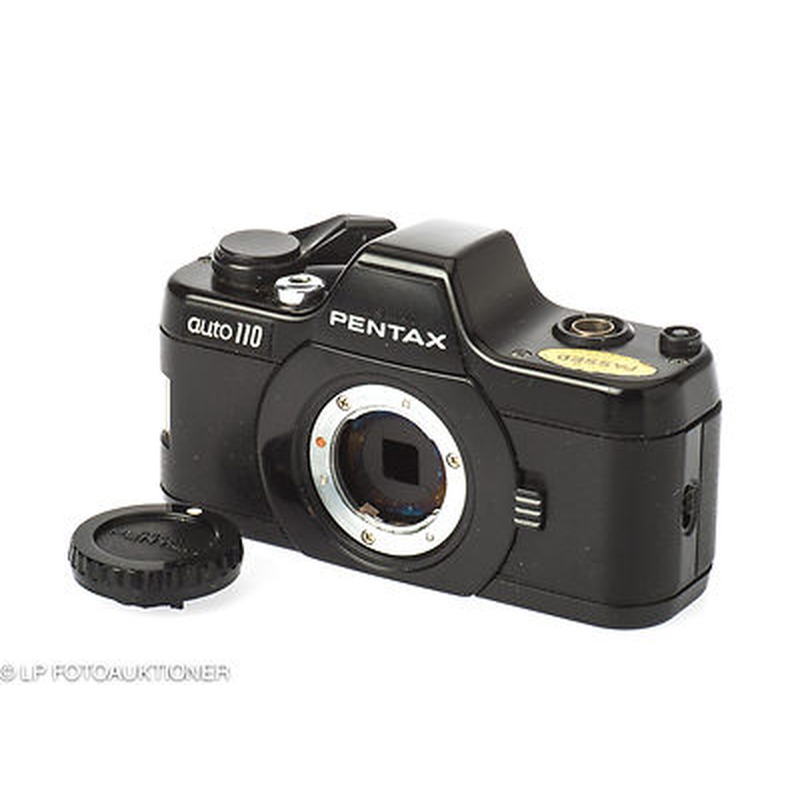
The Pentax Auto 110 (outfit) represents a significant, albeit niche, chapter in SLR miniaturization. Released in 1979, it was the world's smallest interchangeable lens 35mm SLR camera, leveraging the compact 110 film cassette. The "outfit" typically included the body and standard wide-angle lens (e.g., 18mm f/2.8), forming a highly portable yet technically complete system. Its core innovation was packing a full-auto exposure system with a through-the-lens (TTL) CdS meter and shutter-priority automation into an extremely small metal chassis. Designed by legendary Pentax engineer Noriyuki Kusunoki, it shared its 24x18mm image format with the Instamatic system but offered vastly superior control and lens interchangeability via a unique bayonet mount. While handling was compromised due to its diminutive size, it achieved remarkable compactness without sacrificing fundamental SLR functionality, appealing to photographers prioritizing portability.
Though technically sophisticated and impressively small, the Auto 110 faced inherent limitations from the 110 film format itself, offering lower resolution and fewer exposure options than standard 135 film. It occupied a unique position, bridging the gap between fixed-lens pocket cameras and bulky professional SLRs. The camera and its complementary set of small, sharp lenses (24mm, 50mm, 70mm) were Pentax's response to the growing demand for compact travel gear, demonstrating the company's engineering prowess in pushing size boundaries while maintaining photographic capability. Its production run from 1979 to 1983 reflects a period when miniaturization was key, but it remained a specialized tool rather than a mass-market success.
Specifications
| Film Format | 135 |
/main.jpg)
/main.jpg)
 Enjoy this museum? Support on Ko-fi