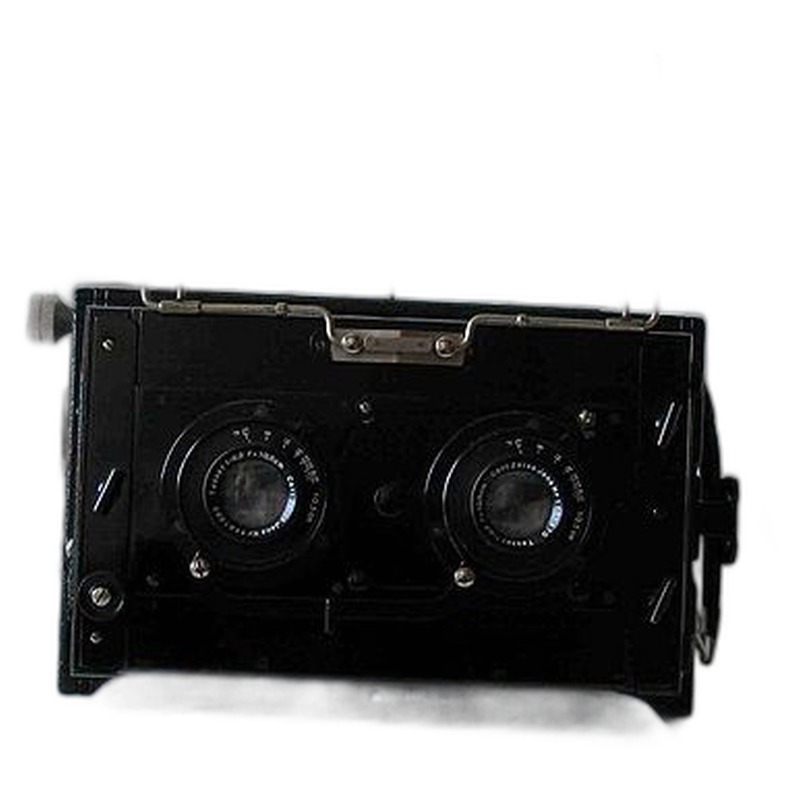
Zeiss Stereo-Nettel
Zeiss · Germany · 1927–1930 (3 years) · 135 film
The Stereo-Nettel represents a fascinating but niche chapter in Zeiss Ikon's history, showcasing the manufacturer's exploration of stereo photography on 135 film. Produced from 1927 to 1930, it was essentially a modification of the popular Nettel series rangefinder cameras, adapted to expose two images side-by-side on the standard 35mm film strip. This allowed photographers to capture stereo pairs that could be viewed with a special stereoscope, offering a three-dimensional viewing experience at a time when stereo imaging was a popular pastime. The camera maintained the reliable coupled rangefinder and precise leaf shutter mechanisms characteristic of the Nettel lineage, embodying Zeiss's engineering prowess for specialized applications. While not a mainstream success, it stands as an early example of 135 film being repurposed beyond standard still photography into the stereo realm.
Designed for the amateur stereo enthusiast, the Stereo-Nettel was likely a premium offering within its niche segment. Its significance lies more in Zeiss's adaptability and the enduring appeal of stereo photography than in broad technological innovation. It exemplifies the period's experimentation with different photographic formats and viewing methods on the nascent 135 platform. Today, it holds interest primarily for collectors specializing in stereo equipment or Zeiss Ikon's specific product lines, serving as a tangible link to a pre-war era when stereo imaging was a significant, if not dominant, format alongside conventional flat photography.
Specifications
| Film Format | 135 |
/main.jpg)
/main.jpg)
/main.jpg)
/main.jpg)
 Enjoy this museum? Support on Ko-fi