Pricing
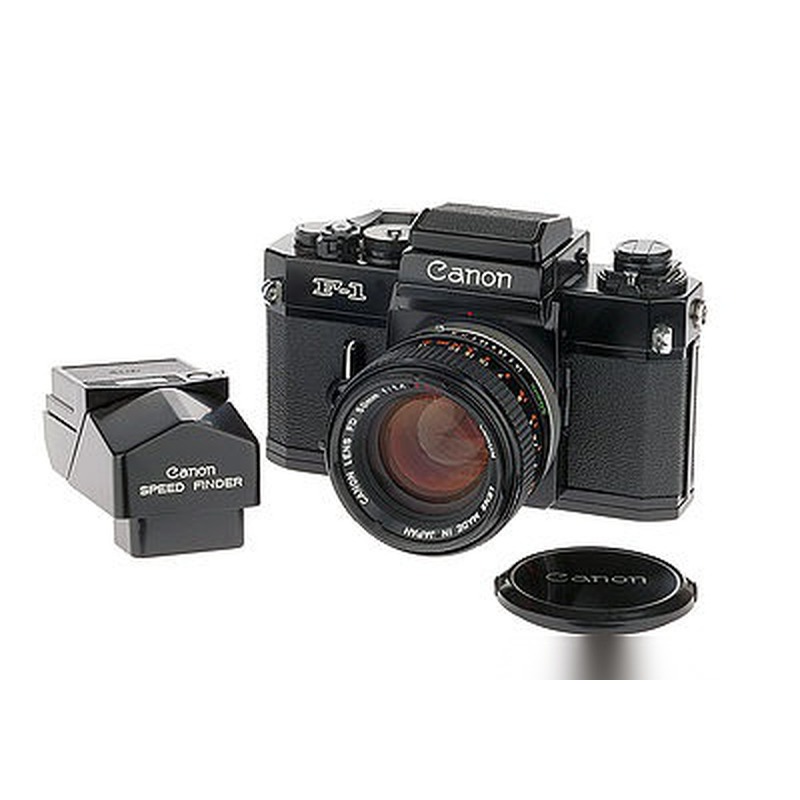
Canon F-1
Canon · Japan · 1971–1981 (10 years) · 135 film
Introduced in 1971, the Canon F-1 was Canon's meticulously crafted response to the dominance of the Nikon F in the professional 35mm SLR market. Built to be a robust, modular, and highly versatile system camera, it targeted photojournalists, studio photographers, and serious enthusiasts demanding performance and reliability. The F-1 featured an all-metal chassis designed for exceptional durability, utilizing precision components and weather sealing to withstand harsh conditions common in professional assignments. Its core innovation lay in its modular design: photographers could interchange focusing screens, finders (including a rare pellicle finder), motor drives, and backs, tailoring the camera specifically to their needs without sacrificing the core camera body's integrity. This modularity was a direct challenge to Nikon's system and established Canon as a serious contender for the professional crown.
The F-1 gained significant traction among influential photographers throughout its decade-long production run, becoming the tool of choice for those seeking an alternative to Nikon without compromising on quality or capability. Renowned photojournalists, documentary photographers, and photo agencies frequently employed the F-1 system to capture world events and iconic imagery, cementing its reputation as a dependable workhorse. Its straightforward controls, bright viewfinder, and compatibility with Canon's expanding range of high-quality FL and later FD lenses solidified its position. The camera was succeeded in 1981 by the New F-1, which further refined the concept, but the original F-1 remains a landmark in Canon's history, marking the point where the company truly established itself as a leading force in professional photography equipment. Its design philosophy of modularity and ruggedness set a standard for system SLRs for years to come.
Specifications
| Film Format | 135 |
/main.jpg)
 Enjoy this museum? Support on Ko-fi