Pricing
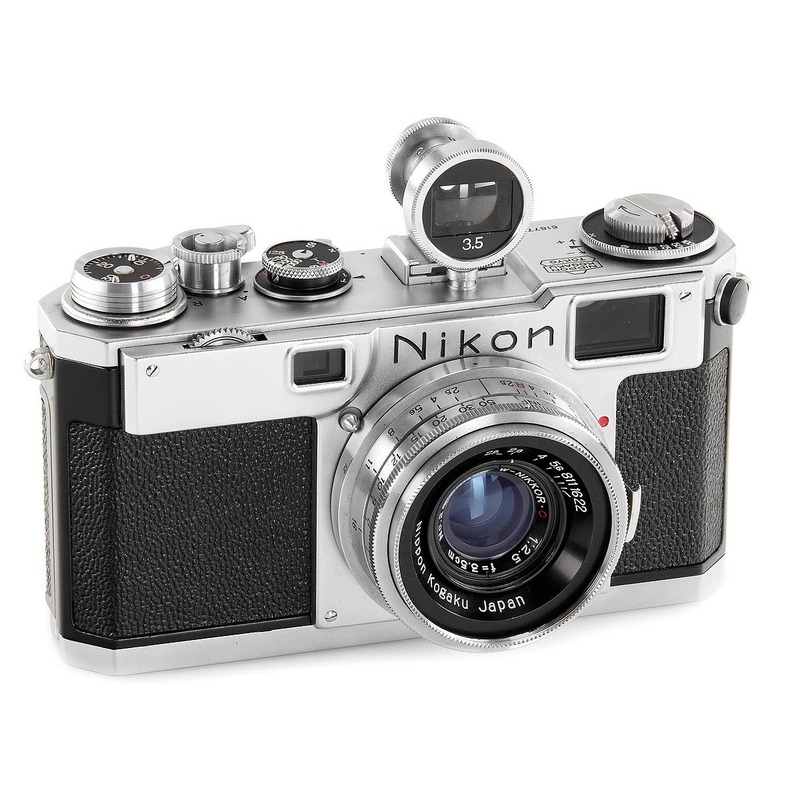
Nikon S2
Nikon · Japan · 1954–1958 (4 years) · 135 film
The Nikon S2 represented a pivotal refinement in Nikon's post-war rangefinder development, building upon the success of the earlier I and II models while directly addressing limitations in competing cameras like the Leica III series. Released in 1954, it departed from the Contax-influenced design of its predecessors to feature a Contessa-Leca inspired coupled rangefinder system integrated with a bright, clearly marked viewfinder, offering exceptional focusing accuracy and visibility. This crucial innovation, combined with a rapid-winding mechanism and a redesigned film advance, made the S2 exceptionally fast and reliable for professional photojournalists and reportage photographers during the 1950s. Its robust construction, incorporating a cast aluminum alloy body and precision mechanicals, set a new standard for durability in 35mm rangefinders, solidifying Nikon's reputation as a maker of precision instruments for serious work. While later overshadowed by the revolutionary Nikon F SLR (1959), the S2 was the camera of choice for many esteemed photojournalists capturing post-war Asia and Europe, contributing significantly to Nikon's growing international prestige and technological reputation.
As a fully coupled, precision 35mm rangefinder, the S2 offered a sophisticated shooting experience for its era. It featured a top shutter speed of 1/500s, flash synchronization, and interchangeable lenses (starting with the Nikkor 5cm f/1.4 and wide-angle options), appealing to professionals requiring versatility. The camera's clean layout and intuitive controls facilitated rapid handling, making it a dependable tool in fast-paced documentary and press environments. Its production run from 1954 to 1958 cemented its role as a bridge between Nikon's rangefinder legacy and its future dominance in the SLR market, embodying the brand's commitment to precision engineering aimed at professional users.
Specifications
| Film Format | 135 |
/main.jpg)
/main.jpg)
/main.jpg)
 Enjoy this museum? Support on Ko-fi