/main.jpg)
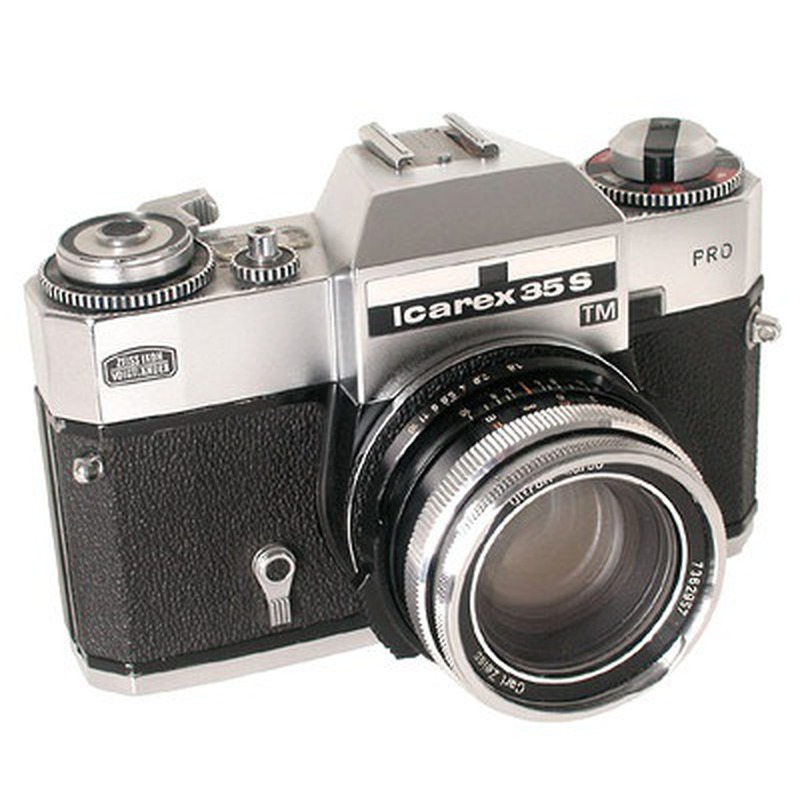
Zeiss Icarex 35 (BM)
Zeiss · Germany · 1969–1972 (3 years) · 135 film
The Icarex 35 (BM) represents Zeiss Ikon's significant effort to establish a foothold in the competitive 35mm single-lens reflex (SLR) market during the late 1960s. Sharing its basic design with the Voigtländer VSL models (as Zeiss had acquired Voigtländer), the Icarex 35 (BM) positioned itself as a competent, feature-rich alternative to offerings from giants like Nikon and Canon. It utilized a Prontor reflex shutter with speeds typically ranging from 1 to 1/1000 second, and crucially, it accepted Zeiss Ikon's proprietary B-mount lenses, offering a range of high-quality optics including the renowned Planar and Tessar designs. The camera body incorporated a through-the-lens (TTL) exposure metering system, a significant advancement at the time, coupled with a match-needle display for precise exposure control. Its construction, adhering to Zeiss standards, emphasized durability and precision, featuring a robust metal body and refined mechanics, though it lacked some of the ergonomic refinements of contemporary rivals.
While technically capable and benefiting from Zeiss optical excellence, the Icarex 35 (BM) ultimately did not achieve legendary status within the photographic pantheon. Its production run was relatively short (1969-1972), and despite its professional aspirations, it faced stiff competition and struggled to gain widespread market dominance against more established SLR systems. Its legacy lies primarily as a testament to Zeiss Ikon's engineering ambition during a tumultuous period for the company (which merged into Zeiss-AG in 1971) and as a capable camera that provided high-quality results with excellent lenses, though it remains a notable rather than transformative figure in 35mm SLR history.
Specifications
| Film Format | 135 |
_(10.2200)/main.jpg)
_(Bundeswehr)/main.jpg)
_(black)/main.jpg)
_(chrome)/main.jpg)
_(10.2800)/main.jpg)
 Enjoy this museum? Support on Ko-fi