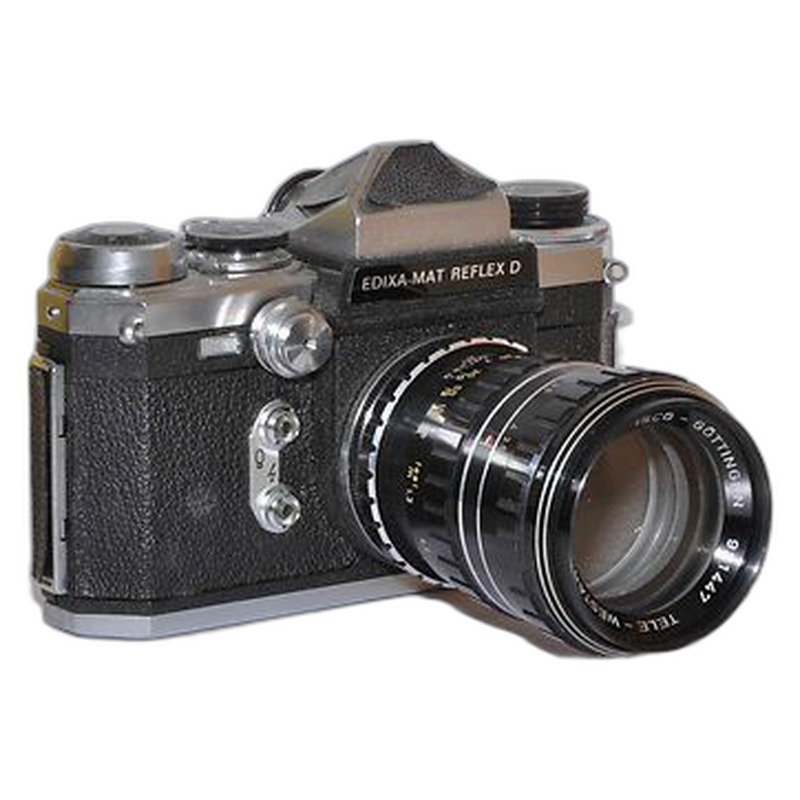
Wirgin Edixa Mat Reflex D
Wirgin · Germany
The Edixa Mat Reflex D represents Wirgin's entry into the mid-range twin-lens reflex (TLR) camera market, likely manufactured during the post-World War II era, circa the 1950s or early 1960s. As a TLR, it features a viewing lens on top and a taking lens below, both coupled and fixed-focus in the simplest versions, though some models may have offered basic focusing scales or aperture/shutter control on the lens board. Wirgin positioned the Edixa line as an affordable alternative to more prestigious German and European brands like Rolleiflex or Zeiss Ikon, targeting amateur photographers seeking a reliable medium format camera without significant expense. Constructed primarily with metal bodies and basic mechanisms, it offered a straightforward approach to 120 film photography, typically producing 6x6 cm exposures. The "Mat Reflex" designation specifically denotes this TLR design, distinguishing it from Wirgin's single-lens reflex (SLR) models like the Edixaflex.
While not an innovator or featuring groundbreaking technology, the Edixa Mat Reflex D served a practical purpose in its market segment. It provided a functional entry point into medium format TLR photography, leveraging Wirgin's established manufacturing capabilities. Its significance lies less in pioneering design and more in providing accessible German engineering to budget-conscious consumers during a period of significant growth in amateur photography. It embodies the era's trend towards reliable, workhorse cameras for the serious enthusiast rather than professional tools, contributing to the democratization of quality image-making.

/main.jpg)
/main.jpg)
 Enjoy this museum? Support on Ko-fi